Thinking about how to become a phlebotomist, but not sure where to start? Becoming qualified as a phlebotomist is one of the most direct pathways into the healthcare sector in Australia – and you don’t need a university degree to get there.
With the right pathology collection course, you can be qualified and job-ready in under 12 months. This guide covers everything: what the role involves, what qualifications you need, how much you can earn, and the fastest way to get started.
Key Takeaways
- A phlebotomist (also called a pathology collector) collects blood and other specimens from patients for laboratory testing, with no nursing degree required.
- The key qualification is the HLT37525 Certificate III in Pathology (Pathology Collection Specialisation), a nationally recognised VET qualification.
- Training typically takes up to 12 months and combines face-to-face practical sessions, self-paced online learning, and a minimum 35-hour clinical placement.
- Phlebotomists in Australia earn a median of approximately $66,976 per year before tax, with room to grow through specialisation and experience.
- Government funding may be available for eligible students
What is a Phlebotomist?
So, what is a phlebotomist, exactly? In Australia, the terms “phlebotomist” and “pathology collector” are used interchangeably. Both refer to a trained healthcare professional who collects blood and other biological specimens from patients to support diagnosis, monitoring, and treatment.
Phlebotomy is a genuinely patient-facing role. You’re often the first point of clinical contact for someone who may be nervous, unwell, or coming in for routine monitoring. A good phlebotomist is technically skilled, calm under pressure, and able to put patients at ease quickly.
Employment of pathology collectors and phlebotomists is projected to grow much faster than the average for all occupations, as doctors increasingly rely on blood and tissue tests to diagnose illness and disease. It’s a field with real momentum.
What Does a Phlebotomist Do Day-to-Day?
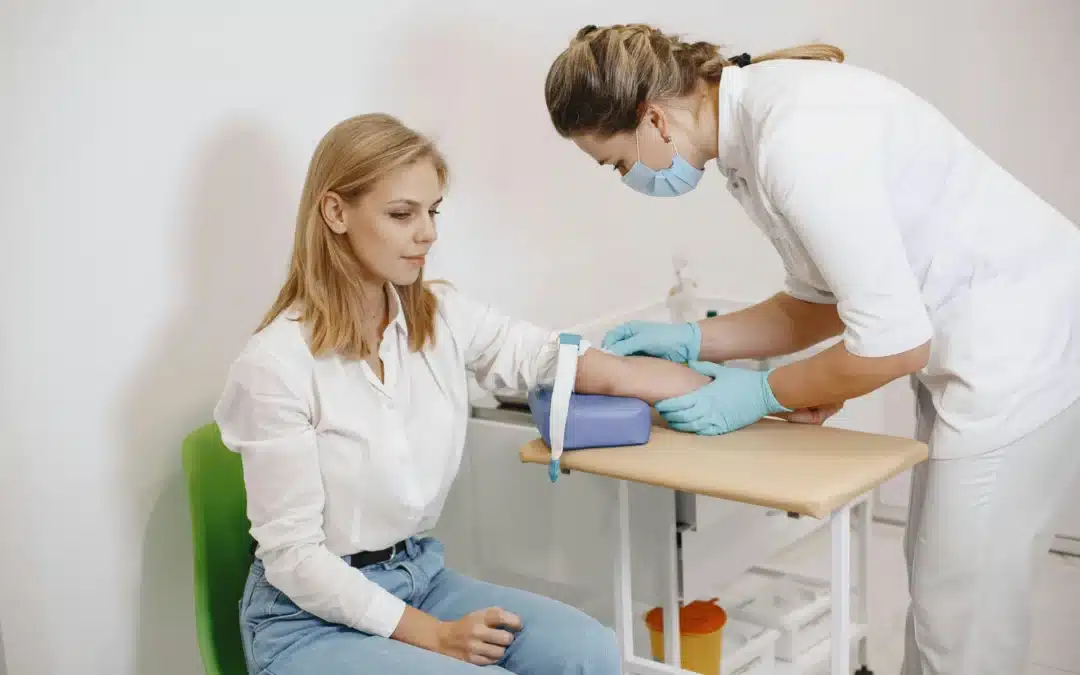
The core task is venepuncture – drawing blood from a vein using a needle and collection tube – but the role extends well beyond that.
On a typical day, you might be involved in several of these duties:
- Performing venous blood collections from patients across a range of age groups and clinical conditions
- Collecting non-blood specimens such as urine, swabs, saliva, skin scrapings, and breath samples
- Explaining collection procedures to patients clearly and calmly, especially those who are anxious or needle-averse
- Labelling, handling, and preparing specimens for transport and laboratory testing
- Following strict infection control and sharps disposal protocols
- Entering patient and specimen data accurately into collection systems
- In some roles: conducting drug and alcohol (AOD) testing in workplace settings, or performing electrocardiography (ECG)
The pace can be brisk, particularly in busy pathology collection centres or hospital settings with high patient volumes. It’s a role that suits people who like variety, clinical interaction, and the satisfaction of doing precise, meaningful work.

Do You Need a Nursing Degree to Become a Phlebotomist?
No – and this is one of the biggest misconceptions about the role. You do not need a nursing degree, a science degree, or any prior tertiary qualification to pursue phlebotomy as a career. It’s a Certificate III level qualification under the Australian Qualifications Framework (AQF), making it accessible to school leavers, career changers, and those returning to the workforce.
No prerequisite studies are required beyond a reasonable level of English literacy and numeracy. Most training providers require a language, literacy, and numeracy (LLN) assessment at enrolment – this is a standard entry process, not a selective exam.
That accessibility is part of what makes phlebotomy such an appealing entry point into the health sector. It’s a direct pathway into clinical work, without the time and cost commitment of a degree.
Step-by-Step on How to Become a Phlebotomist
Here’s a clear picture of how to become a phlebotomist in Australia from start to finish.
Step 1: Complete your LLN assessment
Before enrolling, you’ll complete a short Digital Language, Literacy, and Numeracy (DLLN) assessment with your chosen training provider. This ensures you’re set up to succeed in the course and helps trainers tailor support where needed.
Step 2: Gather your documentation
You’ll need photo ID, proof of residency or citizenship, and a Unique Student Identifier (USI). You’ll also be asked to provide vaccination evidence or proof of immunity for Hepatitis B (and ideally Hepatitis A). This is a standard requirement for clinical training environments.
Step 3: Enrol in the HLT37525 Certificate III in Pathology
The core qualification is the HLT37525 Certificate III in Pathology (Pathology Collection Specialisation) – the current, nationally recognised qualification for phlebotomists in Australia. Training is delivered through a blend of face-to-face classroom sessions, self-paced online learning, and a mandatory clinical placement, with students having up to 12 months to complete the qualification.
Step 4: Complete your clinical placement
A minimum of 35 hours of supervised clinical placement in an approved healthcare setting is required to demonstrate competency. This is where classroom learning becomes real-world capability – and where many students secure employment leads. Quality training providers arrange placement for you.
Step 5: Enter the workforce
Once qualified, you’re eligible to work as a phlebotomist or pathology collector across a wide range of healthcare settings. Many graduates move into employment during or immediately after their placement.
What Skills and Qualities Does a Phlebotomist Need?
Technical competence is the foundation, but it’s not the whole picture. The most effective phlebotomists combine clinical precision with strong interpersonal skills. Key qualities include:
- Attention to detail: Accurate labelling and specimen handling directly affect patient outcomes and diagnostic reliability
- Calm communication: Working with anxious, elderly, or paediatric patients requires patience and a reassuring manner
- Manual dexterity: Venepuncture requires confident, controlled technique, particularly with difficult veins
- Infection control discipline: Adherence to protocols is non-negotiable in any clinical setting
- Time management: High-volume collection days require efficiency without cutting corners
These are all skills that can be developed through quality, face-to-face training, particularly in environments where you practise on prosthetic training arms before progressing to supervised live collections.
Where Do Phlebotomists Work in Australia?
One of the genuinely appealing aspects of phlebotomy is the breadth of workplaces. Qualified phlebotomists and pathology collectors work across:
- Pathology collection centres (private providers such as Australian Clinical Labs, Healius, and QML Pathology)
- Public and private hospitals – across inpatient, outpatient, and emergency departments
- GP clinics and specialist medical rooms
- Blood donation centres (Australian Red Cross Lifeblood)
- Aged care and disability support settings
- Home visit collection services for patients who can’t travel to a centre
- Workplace health settings – conducting drug and alcohol testing for employers
Phlebotomist Salary and Career Progression
Check out our salary guide for a detailed breakdown, but here’s the overview.
A full-time phlebotomist in Australia generally earns $1,288 per week ($66,976 annually) before tax, according to Australian Government Labour Market Insights data. Entry-level roles typically start in the $58,000–$60,000 range, with experience and specialisation pushing earnings higher. Location also plays a role; metropolitan roles generally attract higher rates than regional positions.
Career Progression Opportunities
Phlebotomy isn’t a dead end – it’s a strong foundation. From there, qualified practitioners commonly progress into:
- HLT37415 Certificate III in Pathology Assistance – broadening your scope to include laboratory specimen processing and support functions
- HLT47715 Certificate IV in Medical Practice Assisting – expanding into clinical assisting roles across GP and specialist settings
- Enrolled or Registered Nursing – the HLT37525 Certificate III in Pathology provides recognised credit toward nursing pathways
- Senior and supervisory roles – experienced phlebotomists can move into team leader, training, or area coordinator positions within large pathology networks
- Drug and alcohol testing (AOD) – an elective often included in phlebotomy training that opens up additional workplace health opportunities
The Fastest Way to Become a Qualified Phlebotomist
Understanding how to become a phlebotomist is the easy part, and choosing a training provider that genuinely prepares you for the job is what makes the difference. Face-to-face training with experienced practitioners, in a real clinical learning environment, gives you the practical confidence that online-only courses simply can’t replicate.
If you’re serious about how to become a phlebotomist and want to do it properly, Adept Training can help you get there.
Adept Training is a nationally registered RTO (RTO 90991), recognised as a High Performing Provider by the NSW Department of Education, with almost three decades of experience training pathology collectors in Sydney. Our pathology collection course is delivered face-to-face, which means you get hands-on practice from day one: starting on prosthetic training arms and progressing to supervised live collections before entering placement. That practical foundation makes a real difference in the field. Through our partnership with 4Cyte Pathology, we operate our own LCC-licensed collection centre right next to our Harris Park campus, easing your mandatory 35-hour placement.
Classes run on weekends and weekdays across Sydney to suit different schedules.Government funding through NSW Smart and Skilled is available to eligible students, meaning your course fee could be significantly reduced or covered in full. Eligibility conditions apply.
FAQs
Most students complete the qualification within 6 to 12 months, depending on whether they study full-time or part-time and the delivery model of their chosen provider. At Adept Training, students have up to 12 months to complete the course.
Yes, it’s a stable, patient-facing healthcare role with consistent demand, clear progression pathways, and the genuine satisfaction of doing work that matters. Employment in the field has grown significantly over the past five years and is projected to continue rising alongside demand for diagnostic testing.
In Australia, “phlebotomist” and “pathology collector” are used interchangeably by employers. The role and the qualification (HLT37525 Certificate III in Pathology) are identical regardless of job title.
No – clinical placement is a mandatory component of the qualification. A minimum of 35 hours in an approved healthcare setting is required to demonstrate real-world competency. This is a patient safety requirement, not a formality.
Government-subsidised training is available to eligible NSW residents through the Smart and Skilled program. Visit our funding page for eligibility criteria and how to apply. Funding availability is limited, so it’s worth checking early.