
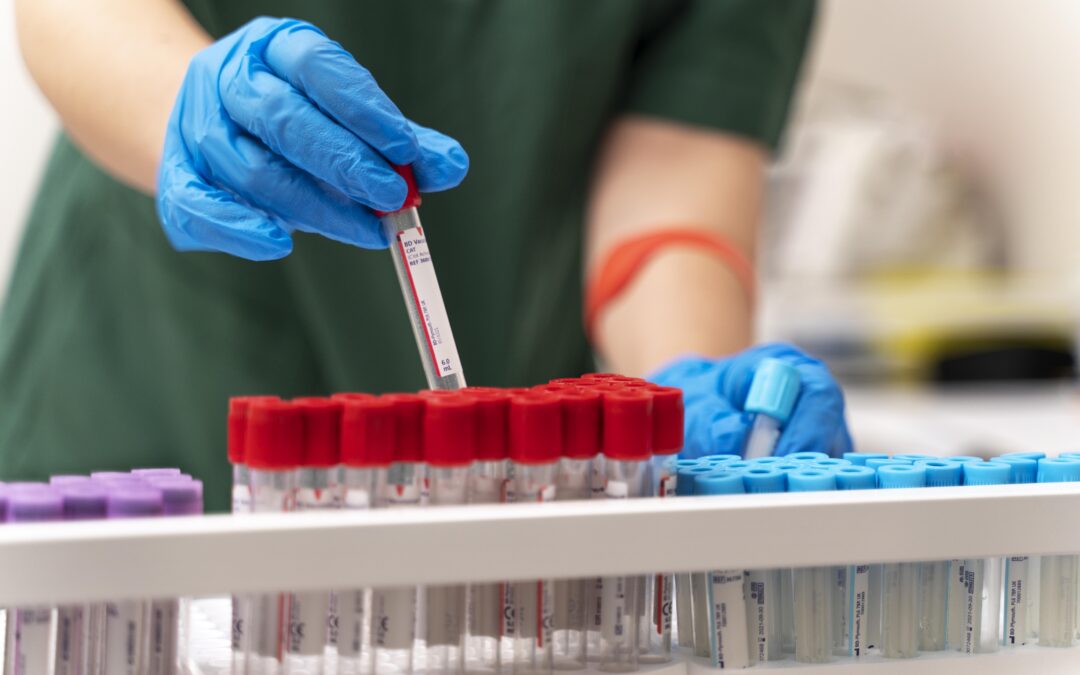
If you’re exploring a career change into healthcare, you’ve probably come across both “pathology collector” and “pathology assistant” while researching your options. The titles sound similar, and the courses often sit side by side on training provider websites, so it’s easy to assume they lead to the same job.
In practice, they are quite different. Both roles sit within Australia’s pathology sector, and both are in steady demand. But one puts you face-to-face with patients, while the other keeps you behind the scenes in a laboratory.
Knowing the difference before you enrol means you can choose the training that matches the work you want to be doing in six months’ time.
Quick Comparison at a Glance
| Pathology Collector | Pathology Assistant | |
|---|---|---|
| Core duties | Collecting blood, urine, and other specimens from patients | Receiving, sorting, accessioning, and preparing specimens in the lab |
| Patient contact | High | Minimal |
| Typical setting | Collection centres, hospitals, GP clinics, aged care | NATA-accredited laboratories |
| Qualification | HLT37525 Certificate III in Pathology (Pathology Collection) | HLT37525 Certificate III in Pathology (Pathology Assistance) |
| Entry pay | ~$55,000 to $65,000 per year | ~$55,000 to $65,000 per year |
What Is a Pathology Collector?
A pathology collector is usually the person a patient meets when they arrive for a blood test. It is a patient-facing role with real clinical responsibility.
Collectors work across collection centres, hospital wards, GP clinics, aged care facilities, and mobile services. Their job is to collect specimens and make sure each sample reaches the lab in the right condition for testing.
On a typical shift, this can include:
- Performing venepuncture: Drawing blood from a vein, usually in the arm or hand
- Collecting non-blood specimens: Urine, swabs, saliva, and other sample types as requested
- Confirming patient identity and reviewing referral forms
- Labelling and documenting each specimen precisely
- Preparing and dispatching samples within required timeframes
- Following infection control protocols throughout every procedure
The role also involves people skills. Patients may be anxious, needle-phobic, or unwell, so a good collector keeps the process calm, safe, and efficient.
Laboratory test results inform around 60% to 70% of medical decisions, so accurate collection matters from the start.
What Is a Pathology Assistant?
A pathology assistant works inside the laboratory, not directly with patients. The role is process-driven, and most of the work begins once specimens have been collected.
Pathology assistants are usually based in NATA-accredited laboratories, helping keep the specimen workflow accurate and organised.
Core responsibilities include:
- Receiving incoming specimens and checking them against request forms
- Sorting samples by test type and urgency
- Accessioning: Entering specimen data into the laboratory information system
- Preparing samples for analysis (centrifuging, aliquoting, labelling)
- Maintaining specimen storage and chain of custody records
- Supporting laboratory staff with operational and administrative tasks
The role follows AS/NZS pathology standards in a controlled lab environment. Patient contact is minimal. The focus is on precision, process, and making sure every step is handled correctly.

Key Differences
Patient contact
Collectors work directly with patients all day. Assistants rarely interact with them. If people are the reason you’re drawn to healthcare, collection is the patient-facing choice.
Work environment
Collectors move through various settings, including collection centres, hospitals, clinics, and, sometimes, patients’ homes. Assistants generally work in one location, within a laboratory.
Core skills
Collectors need venepuncture technique and communication skills to manage a wide range of patients. Assistants need precision with data, comfort with laboratory systems, and methodical working habits.
Responsibility scope
Both roles carry serious responsibility for specimen integrity. For collectors, it sits at the point of collection. For assistants, it sits across the receiving and processing chain.
Training and Qualifications
Pathology collector
The nationally recognised qualification is the HLT37525 Certificate III in Pathology (Pathology Collection Specialisation), completed through an RTO. It covers venepuncture, specimen handling, infection control, and patient communication.
Training can be completed in a matter of months. At Adept Training (RTO 90991), the course is delivered face-to-face in a real clinical environment, so practical skills are built from the start.
Pathology assistant
The recognised pathway is the HLT37525 Certificate III in Pathology (Pathology Assistance Specialisation). Some assistants enter the role through on-the-job training, but formal qualifications provide a stronger foundation and nationally recognised credentials.
Venepuncture is not a mandatory requirement for the assistant role.
Salary and Career Progression
Entry-level pathology collectors start from $55,000 per year, with the national average for full-time collectors ranging from $62,000 to $72,000. With experience, the role can lead to senior collection, supervisory positions, or further study in medical science or laboratory technology.
Pathology assistants sit in a comparable range at the entry level. Experience in NATA-accredited labs can lead to higher classifications over time, and the role is also a practical pathway into collection work or laboratory technician roles.
Which Role Is Right for You?
A few questions can help you decide:
- Do you feel comfortable with venepuncture and direct patient contact?
- Do you prefer working with people, or do process and precision suit you better?
- Would you rather work across clinical settings or in a structured lab environment?
- Are you looking for training you can complete in a few months?
If you’re comfortable with needles and patient care, pathology collection may be the better fit. If you prefer methodical, behind-the-scenes work, pathology assistance may suit you better.
Both roles are in demand. The question is where you want to spend your working day.
Adept Training (RTO 90991) offers both qualifications through face-to-face, hands-on delivery. Explore HLT37525 Certificate III in Pathology to find the right next step.
FAQs
Yes. In Australia, pathology collectors need a nationally recognised qualification, such as the HLT37525 Certificate III in Pathology (Pathology Collection Specialisation), completed through an RTO. Some employers may accept the HLTSS00059 Venous Blood Collection Skill Set as a minimum entry requirement, so check directly before enrolling.
Not exactly. The terms overlap, but a pathology assistant works specifically in a pathology lab, handling specimen receiving, accessioning, and sample preparation in accordance with AS/NZS pathology standards. A lab assistant may work across broader scientific settings.
Pathology collectors generally earn slightly more at the entry level, reflecting their clinical training and venepuncture competency. JobOutlook lists average full-time earnings at around $1,159 per week. Pathology assistants often start slightly lower, though both roles can progress over time.
Yes, some people start in pathology assistance before moving into collection. To become a pathology collector, at a minimum, you’ll need the HLTSS00059 Venous Blood Collection Skill Set, though many employers expect the full HLT37525 qualification completed through an RTO.